

Smart machinery investments can drive sustainable growth
Bringing Block Production In-House: The Utilization Test Before You Buy
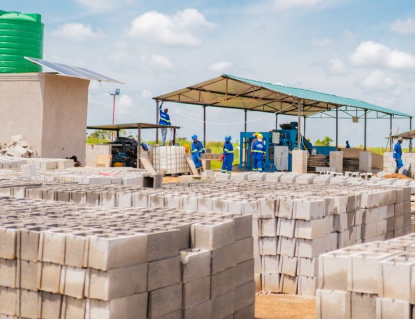
Every builder who buys blocks from someone else eventually asks whether to make them. The question is usually framed as a price comparison — my supplier charges this much, the machine costs that much — and that framing is why so many small block plants sit idle. The real question is not whether you can produce on site, it is whether the volume justifies the plant, and that turns on utilization: how many hours a week the machine will actually run.
Quick answer
- In-house block production is a utilization decision, not a price decision. Below roughly two full days a week of machine time, buying blocks usually wins.
- The block making machine is the smallest part of the capital: foundation, molds, pallets, mixer, curing area, and power connections add up to more.
- Cement and aggregate are the largest running cost and the one the buyer controls least.
- In-house production fixes lead time, specification control, and waste handling. It does not fix cement price, land, or demand seasonality.
- Run the annual requirement through the arithmetic below before requesting a quotation, not after.
Why builders look at it at all
Three reasons come up in almost every inquiry, and only one of them is about money.
Lead time. A project that needs 40,000 blocks next month cannot wait for a supplier's queue. On-site production removes the queue, and on a phased project it lets output follow the structure rather than the delivery schedule.
Specification control. When the wall drawing calls for a specific block height or compressive class, a supplier's standard product may not match it. Producing on site means the mold matches the drawing rather than the drawing being adapted to whatever is in the yard.
Waste. Construction sites generate broken block, surplus mortar, and cut-offs. Some of that can go back into the mix as aggregate, which reduces what leaves the site in a waste container. This is a real benefit and a modest one; it is not a reason to buy a plant on its own. Machine sizes from manual to fully automatic are listed under concrete block machines, and the medium block making machine range is the usual starting point for a project-scale plant.
The arithmetic to run first
The test is a division problem. Work out your annual block requirement, then work out how many machine hours that requirement takes, then look at how many hours a year the machine would realistically be available. If the requirement uses less than about a third of available hours, the plant will spend most of its life idle and its fixed costs will eat the saving.
| Input you need | Where it comes from |
|---|---|
| Annual block requirement | Your project pipeline, in units, by block type |
| Blocks per hour at your mold | Cavity count divided into the forming cycle, then discounted for real stops |
| Hours available per year | Working days times shift hours, minus rainy season and shutdowns |
| Machine, mold, and pallet cost | Quotation, including the second mold and the first spare-parts list |
| Civil and electrical cost | Foundation, hardstanding, curing shed, cable and breaker |
| Mix cost per block | Cement dosage, aggregate, and water at your local prices |
| Labor cost per block | Operator plus helpers on pallets, curing, and dispatch |
| Block price you pay today | Your supplier's delivered price, at your gate |
Put those numbers in one sheet and the decision usually becomes obvious in a way that the price of a concrete block machine never does. Most of the rows are things you already know; the exercise is in seeing them in one place. Two outcomes are common. The first is a builder whose annual requirement is large enough that the plant runs most weeks and pays for itself over a measurable period. The second is a builder whose requirement is a few thousand blocks a year, for whom the honest answer is to keep buying blocks and spend the capital on the building.
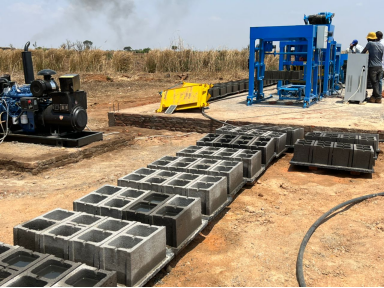
The costs that get left out
The quotation covers the machine. The project covers considerably more, and a concrete block machine quotation that leaves out the items below is not a budget.
- Foundation and hardstanding. A block machine needs a level, load-bearing base, and the pallet and curing areas need a solid surface that keeps pallets flat.
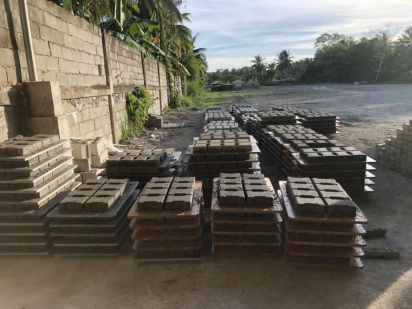
- Pallets. The machine uses one per cycle and the curing area holds most of them. Pallet count is set by curing time, not by machine speed, and under-ordering is the single most common startup mistake.
- Mixing. A mixer, conveyor, and a water source sized to the machine's consumption. Under-sizing the mixer means the machine waits.
- Curing. Covered space, and enough of it that stock can sit for the full curing period instead of being shipped early.
- Power. A connection sized for the machine plus mixer plus conveyors, with the correct protection. Upgrading a site supply is slow and should be started early.
- Molds. One mold produces one product. Most plants need two, and the second one is the difference between serving one job and serving a market.
- Working capital. Cement, aggregate, and pallets are bought before the blocks are sold.
What in-house production does not fix
It does not make cement cheaper, and cement is the largest variable cost in a concrete block. A block making machine changes labor and lead time; it does not change the input price. It does not create demand. An automatic block machine produces faster than most single projects consume, so a plant that outruns its own site ends up selling blocks, which is a different business with different customers. It does not remove quality risk, and in fact it transfers that risk from a supplier with a lab to a site team without one, unless curing and mix control are taken seriously. And it does not scale down well: the fixed costs of foundation, curing area, and power are the same whether the plant runs two days a week or six.
Builders who make in-house block production work tend to share one trait: they treat the block plant as a production unit with a schedule, an operator, and a maintenance routine, not as equipment parked next to the site. That is also the difference between a block factory setup that lasts and one that is resold within two years.
The sequence that works
The order matters, and in-house block production fails most often at step four.
- Step 1. Fix the annual requirement and the block types, in writing.
- Step 2. Test the local aggregate and cement, and settle a mix design with a target strength before you price a block making machine.
- Step 3. Size the automatic block machine to the requirement, not to the budget ceiling.
- Step 4. Design the block factory setup — machine, pallet return, curing, stock — before ordering.
- Step 5. Order mold, pallet, and spare-parts quantities together with the machine.
- Step 6. Commission with the operator who will actually run it, not a stand-in.
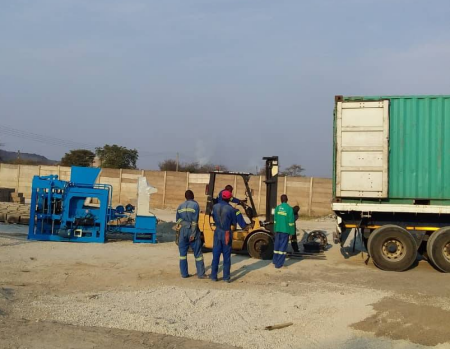
Step four is skipped most often and costs the most to correct later, because moving a curing area after the first pour is expensive and moving a machine after it is anchored is worse.
FAQ
How many blocks a year justify buying a block making machine?
There is no universal number, because it depends on your mold, your block mix, and your local block price. The test is hours of machine time per year against hours available. If production would use less than a third of available hours, buying blocks is usually the better decision.
Can I start with a manual or semi-automatic machine and upgrade later?
Yes, and many block plants start that way. A manual or semi-automatic machine has lower capital and higher labor per block; it is a reasonable way to learn the mix and the market before committing to an automatic line. The molds and pallets are the parts that carry over least, so plan the upgrade path before ordering them.
What is the biggest cost mistake first-time buyers make?
Under-ordering pallets and under-sizing the mixer. Both make a working block making machine look slow, and both are cheap to fix at order and expensive to fix later.
Do I need a covered curing area?
Yes, in almost every climate. Blocks gain strength over days, and rain, wind, or direct sun on green blocks causes surface damage and strength loss that shows up later in the wall.
Send your annual requirement and we will check the arithmetic
Send us your annual block volume, the block types and sizes you need, and the power supply available on site. We will tell you which machine size fits that volume, how many molds and pallets the plant needs, and what the layout has to allow for — including the case where the honest answer is that your volume does not justify a plant yet. Sample testing on your own aggregate is available, and you are welcome to visit the factory or request a video walkthrough of a machine under assembly. Hongbaoyuan has manufactured block machinery for over 5 years, supplies more than 17 countries, and holds ISO 9001:2008 certification. Contact [email protected] or +86-539-8309839.