
4 sets QTJ4-18 Hydraulic block machine in Benin
Four QTJ4-18 Lines for a Paver Producer in Cotonou, Benin
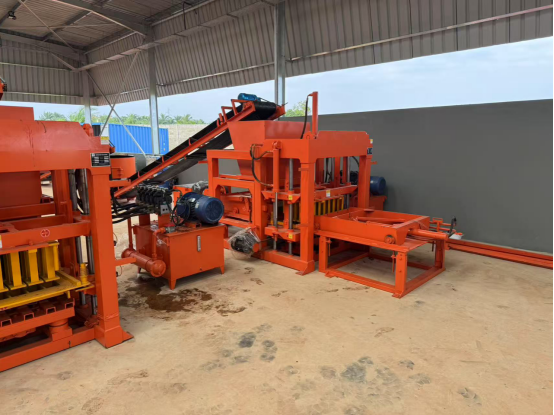
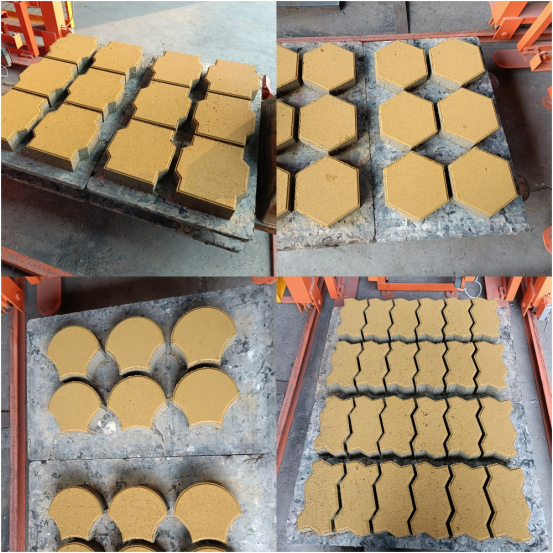
A building materials producer in Cotonou, Benin ordered four QTJ4-18 automatic hydraulic lines for concrete paving stones. The company supplies pavers into landscaping, footpaths, parks, and garden work across the city, and the order was the step from batch production to a continuous automatic plant serving local infrastructure projects.
Quick answer
- Four QTJ4-18 automatic hydraulic paver block making machines, delivered to Cotonou, Benin.
- Product focus: concrete paving stones for landscaping, footpaths, parks, and gardens.
- The buyer's stated goal was a large-scale automatic production center for local infrastructure work, built around a single paver block making machine design repeated four times.
- Four machines rather than one is a capacity decision: it multiplies output without pushing a single line past its cycle.
- At this scale, pallet inventory and curing area become the real constraints, not the machines.
The project
| Item | Detail |
|---|---|
| Location | Cotonou, Benin |
| Buyer | Building materials producer supplying paving stones locally |
| Equipment | 4 × QTJ4-18 automatic block machine lines, configured for pavers |
| Product | Concrete paving stones and related concrete units |
| Market | Landscaping, footpaths, parks, gardens, infrastructure |
| Objective | Continuous automatic production replacing batch output |
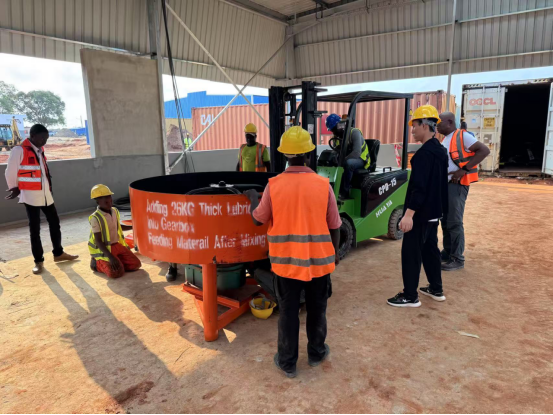
Why a paver producer scales in units of one machine
The instinct when demand grows is to run the existing machine harder. That works to a point and then stops, because a QTJ4-18 is built around an 18-second forming cycle. You cannot compress the cycle without changing what the block is. What you can do is add another machine.
Four machines give the buyer four independent forming cycles on the same automatic block machine design, and that changes what the plant can promise. Product mix stops being a scheduling compromise: two machines can hold the high-volume paver profile while the other two run a second profile or a color batch. Maintenance stops being a plant-wide shutdown: one machine comes down for a mold change or a hydraulic service while three keep producing. And a breakdown costs a quarter of output for a day rather than all of it for a week.
The cost is everything downstream of the machine. Four lines running at rate need four machines' worth of pallets, curing space, mix supply, and people, and that is the part buyers underestimate.
What the QTJ4-18 hydraulic block machine brings to paver work
| Parameter | Value |
|---|---|
| Forming cycle | 18 s |
| Shaping method | Hydraulic press plus vibration |
| Hydraulic pressure | 15–22 MPa |
| Vibration frequency | 4,500 r/min |
| Pallet size | 880 × 550 × 20 mm |
| Power | 22.5 kW |
| Total weight | 4,200 kg |
| Electric source | 220 / 380 / 440 V, 50 or 60 Hz on request |
A hydraulic block machine presses through the same cycle on pavers as it does on blocks, and hydraulic pressing with vibration is the right combination for pavers specifically. Vibration fluidizes the mix so it fills a thin, wide cavity evenly; the hydraulic press then closes the surface and holds the height through demolding. A paver that is short of either one shows it immediately — rounded edges, a porous face, or height drift across the pallet.
Three configuration choices matter more for pavers than for blocks. A color feeding system, if the buyer wants to sell a color paver rather than grey product, and most paving work in landscaping and parks is specified in color. A block stacker, because hand-stacking four lines' output is the labor bottleneck that shows up first. And a batching and mixing arrangement sized to four machines rather than one: at four lines the mixer stops being an accessory and becomes the constraint on the whole plant.
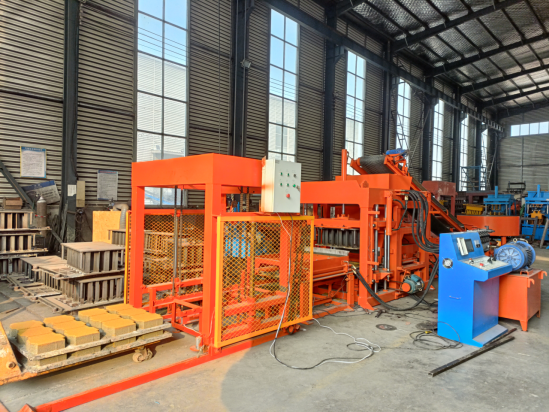
What changes when you go from one line to four
Going from one paver block making machine to four is a plant design problem rather than a purchasing decision, and the constraints move downstream.
Pallet circulation. Every machine needs a pallet per cycle, and every pallet spends far longer in curing than at the machine. A four-line paver production line needs pallet inventory sized against curing time, not against cycle time, and buyers commonly under-order by half at this step.
Curing area. Output goes up fourfold, so the shed has to as well. Stacking green pavers higher to save floor space is the fastest way to lose a batch to deformation, and no hydraulic block machine setting will recover it.
Mix supply. Four machines at an 18-second cycle consume material continuously. Mixer capacity, aggregate stock, and cement delivery all need to be planned on the same clock.
Maintenance windows. With four lines the plant can afford to take one down. It cannot afford to take two down for the same reason, so the mold and spare-parts inventory should be arranged so that no single wearing item stops more than one machine.
People. One operator per machine is the minimum; the helpers on pallets, curing, and dispatch scale with output, and the shift supervisor becomes a real role rather than a formality.
Paving stones are a specification product, not a commodity
Worth saying plainly, because it decides whether a four-line plant makes money. A paver sold into a footpath or a park is bought against a drawing: thickness, color, shape, and edge detail. The buyer of this plant is competing for municipal and landscaped work where the specification is written before the order is placed. That is a better business than selling grey blocks by the unit, and it is also less forgiving — a color batch that does not match the previous one is a rejected delivery, not a discount.
A concrete paver machine is only as good as the profiles it can produce, which is why the mold list deserves as much attention as the machine order. A concrete paver machine with a narrow mold list will always lose work to one that can change profiles, and the difference shows up in the tender stage rather than on the factory floor. Get the profiles and thicknesses that the local spec actually calls for, not the ones that are easiest to mold.
FAQ
How many pavers per hour from one QTJ4-18?
At an 18-second cycle the machine completes about 200 cycles per hour. Blocks or pavers per hour depend on the cavity count of the mold: a four-cavity mold gives roughly 800 pieces per hour at theoretical rate.
Can the machine produce colored pavers?
Yes, with a color feeding system added to the line. Color is applied as a surface layer, so the face layer mix and the base mix are managed separately.
Do we need a stacker with four machines?
Not strictly, but hand-stacking is usually the first bottleneck a multi-line plant hits. A stacker also removes the most repetitive manual task from the shift, which matters for consistency as much as for cost.
Are all four machines the same model?
The order was placed as four QTJ4-18 automatic block machine lines. Whether they run identical molds or split between profiles is the buyer's production decision, and mold sets can be ordered per machine accordingly.
Tell us your daily target and main paver profile
If you are planning a paver plant at this scale, send your target daily output, the paver profiles and thicknesses you intend to sell, and your available power supply. We will return a layout proposal for the number of lines that fits, with the mold, pallet, and mixing configuration that supports it. Sample testing on your own aggregate is available before you commit, and you can visit the factory or request a video walkthrough of a machine under assembly. Hongbaoyuan has manufactured block and paver machinery for over 5 years and supplies more than 17 countries, with ISO 9001:2008 certification. Write to [email protected] or call +86-539-8309839.