

Smart block machine performs well in Romania
Block Machine Installation in Romania: Two Days from Commissioning to First Output
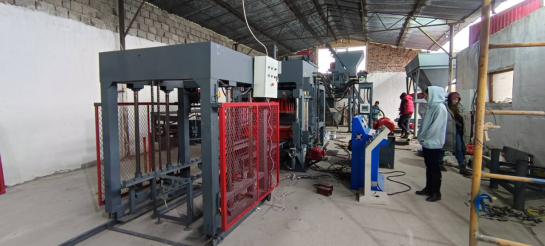
A Romanian producer took delivery of a fully automatic hydraulic block machine in the winter of 2024. The machine was large enough that the buyer asked for our engineer on site rather than remote guidance. He traveled to Romania, commissioned the line, and the plant was producing blocks two days later.
Quick answer
- A fully automatic hydraulic block machine, installed at a Romanian plant in winter 2024.
- Installation and commissioning handled on site by our engineer, at the buyer's request.
- Production reached two days after commissioning began.
- Three mold sets supplied at order: hollow blocks, pavers, and curbs.
- Winter commissioning works, but mix water, curing, and hydraulic oil temperature all need managing.
What the job involved
| Item | Detail |
|---|---|
| Location | Romania |
| Machine type | Fully automatic hydraulic block machine |
| Installation | Our engineer on site, at the buyer's request |
| Molds | Hollow block, paver, and curb molds |
| Time to first production | Two days after commissioning began |
| Season | Winter 2024 |
Why the buyer asked for an engineer on site
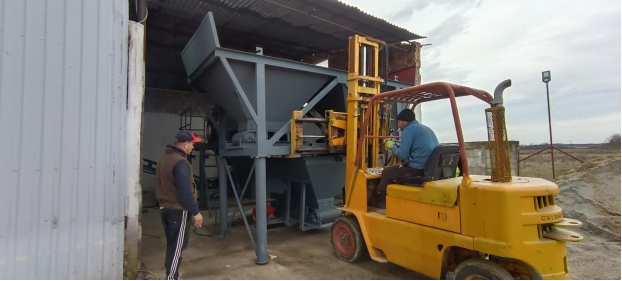
An automatic block machine of this size is not a plug-in appliance. It arrives in sections, gets set on a foundation that has to be level within tolerance, and only then does the hydraulic pressure, the vibration timing, and the mold alignment get set to the product the buyer actually wants to sell. Remote video support gets a plant most of the way there, and for smaller machines it is often enough. For a large automatic line, the buyer's calculation was simpler: a few days of an engineer's time against weeks of trial and error with a new crew.
The buyer's own reasoning was the deciding factor. They had committed to a large machine and a three-product range, and they wanted the first pallets to come off the line at specification rather than close to it.
What two days of block machine installation actually covers
The sequence is not improvised, and that is the reason it fits into two days when the site is ready.
Mechanical first: foundation contact, frame level, guidepost alignment, pallet feed height, and mold clamping. This is the part of block machine installation that cannot be rushed, and it is where most of the first day goes. Nothing electrical is switched on until the mechanical side is right, because a misaligned mold under hydraulic pressure damages itself and the pallet.
Then the hydraulic circuit: pressure set to the range specified for the model, proportional valve response checked, and the press cycle timed against the forming cycle. On a hydraulic block machine the pressure setting and the vibration window are what decide block density and edge quality; both are set with the buyer's own mix, not with a bench sample.
Then the molds, one at a time: the hollow block mold, the paver mold, and the curb mold. Each is mounted, aligned, run, and the first blocks inspected for height, edge, and density. This is where the three-product order earns its keep: a hollow block mold, a paver mold, and a curb mold do not run at the same settings, and the operator needs to see the changeover done once before doing it alone.
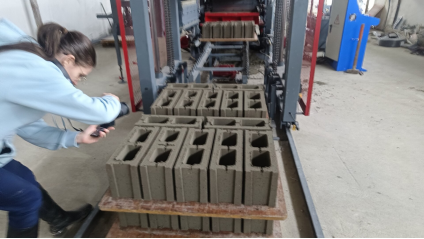
Finally the crew: start-up, stop-down, changeover, daily checks, and the fault list they should escalate rather than fix themselves. Training is part of our after-sales support, and it is delivered on the buyer's machine with the buyer's materials.
Three products, three different settings
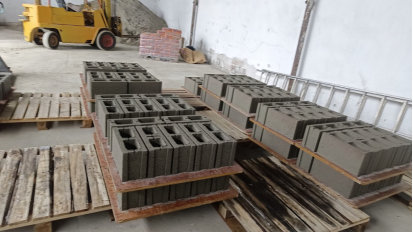
Hollow blocks and pavers look like the same job and are not. A hollow block mold needs enough vibration to fill the cores without collapsing the web, and enough pressure to hold the height through demolding. A paver is thinner and wider, so the fill has to be even across the whole pallet and the surface has to close fully or the edges crumble on the stacker. A curb is a deep, narrow section where the pressure has to be held longer or the top is dense and the base is not.
That is also why the mix changes between products. A mix that runs cleanly as a hollow block will often tear at the edges as a paver, and the fix is in the aggregate grading and the water, not in the machine settings. Buyers who plan three products should plan three mix trials, not one. If you are still choosing between machine sizes, the medium block making machine range covers the hollow block models, and the QTJ4-15 paver line is the version set up for paver and curb work.
Winter is a real constraint, not a disqualifier
The installation happened in winter, which adds three items to the checklist and none of them are the machine's fault.
Mix water at near-freezing temperature slows the cement reaction and produces blocks that look right and cure weak. Hydraulic oil at low temperature is thick, so the first cycles of the day run slow until the circuit warms; the pressure setting has to be verified at working temperature, not cold. And curing in a cold shed needs either heat, insulation, or more time on the pallet before the blocks are stacked. None of this is unusual in northern Europe or Central Asia, and all of it is manageable if it is planned before the engineer leaves rather than discovered in the first cold week of production.
Before the engineer lands: what the buyer should have ready
- Foundation completed and cured, with anchor positions to the drawing and level checked. Block machine installation time is decided here, not on the machine.
- Power supply at the specified voltage and frequency, with the correct breaker and cable to the control cabinet.
- Raw materials on site: cement, aggregate grades, and enough to run three mix trials.
- Pallets unloaded and counted, with storage that keeps them flat.
- A crew assigned to the installation, not borrowed from another job for two hours a day.
- An interpreter if the site team does not work in English, booked for the full commissioning window.
- Lifting equipment sized for the heaviest section, available on the day the container is opened.
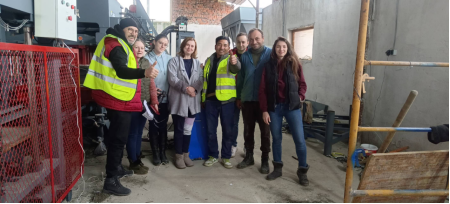
Every item on that list has, at some point, added a week to an automatic block machine startup. The two-day result in Romania was a two-day result because the buyer had all seven ready before the engineer arrived.
FAQ
Does an engineer have to come on site, or can we install it ourselves?
Both are possible. Smaller machines are routinely installed by the buyer's team with drawings and remote support. For large automatic lines, on-site commissioning is the faster route to specification output, and the buyer here chose it for that reason.
How long does installation take?
Two days from the start of commissioning in this project, on a prepared foundation with materials and crew ready. Foundation work, container unloading, and curing area preparation sit outside that window and take longer.
Do the molds come with the machine?
Molds are ordered with the machine. We normally fit the molds a buyer will use most often at installation, so the crew sees each changeover performed once.
Can the machine be commissioned in winter?
Yes. Cold weather affects mix water temperature, hydraulic oil viscosity, and curing time. All three are managed by planning rather than by changing the machine.
Send your floor plan and power supply details
If you are planning an installation like this one, send your factory layout, the voltage and frequency available on site, and the block, paver, or curb profiles you intend to produce. We will return foundation and installation notes for the machine size you need, plus a mold and spare-parts list. You are welcome to visit the factory before ordering or arrange a video walkthrough of a machine under assembly, and sample testing is available on your own mix. Hongbaoyuan has built block machinery for more than 5 years and supplies to over 17 countries; engineers are available to service machinery overseas. Reach us at +86-539-8309839 or [email protected].